


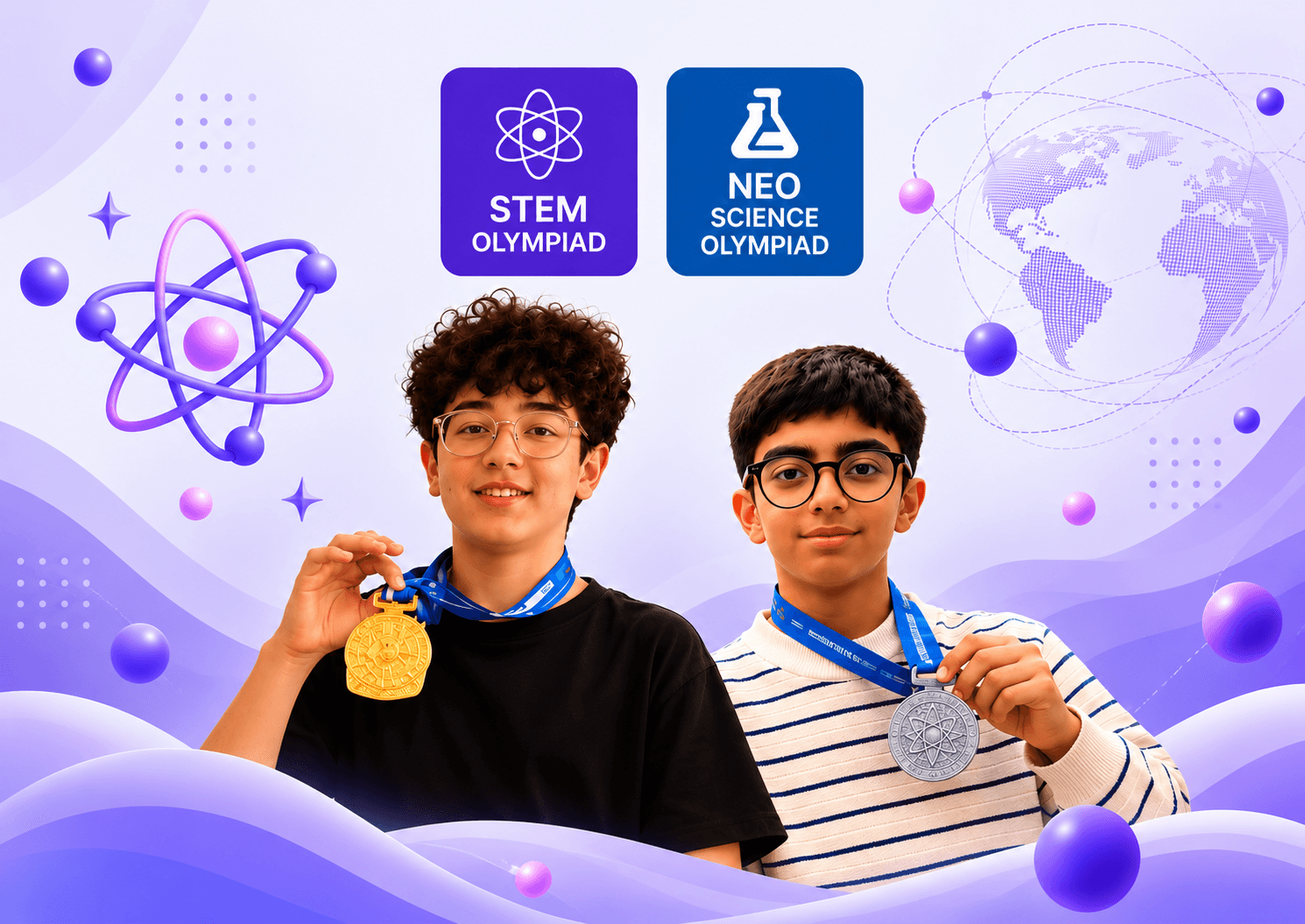
Investing in a child’s future is not limited to improving school grades or helping them complete their homework on time. In today’s world, it is equally important for children to develop analytical thinking, problem-solving skills, creativity, openness to new knowledge, and the ability to compete in an international environment.
From this perspective, international Olympiads and academic competitions have become valuable platforms for children’s development.
International Olympiads in STEM, science, mathematics, coding, and other fields give students more than just the opportunity to win medals. These competitions allow children to test their knowledge in a real competitive environment, develop new skills, and better understand their own potential.
So, what exactly can participating in international Olympiads offer children?
1. Develops Analytical and Logical Thinking Skills
Olympiad problems are often different from the standard questions students encounter at school. A student may not be able to solve a problem simply by applying a familiar rule or formula.
They need to analyze the question, develop the right strategy, compare possible solutions, and choose the most effective approach.
This process helps children develop skills such as:
- Analytical thinking;
- Logical reasoning;
- Understanding cause-and-effect relationships;
- Comparing information;
- Making effective decisions;
- Breaking complex problems into smaller parts.
STEM Olympiads are particularly valuable in this regard because the STEM approach connects science, technology, engineering, and mathematics, helping children approach problems from a more practical and integrated perspective.
2. Strengthens Problem-Solving Skills
One of the most important skills in the modern world is the ability to identify a problem and find an appropriate solution.
During international Olympiad preparation, students encounter problems with different levels of difficulty. Sometimes, a question that initially appears simple may require a completely different way of thinking.
Each time a student makes a mistake, they have an opportunity to analyze it, try a new approach, and develop a better strategy for the next problem.
This approach helps children develop a mindset that is useful not only for Olympiads but also for education and everyday life:
“When I face a problem, I should look for a solution instead of giving up.”
3. Introduces Children to an International Competitive Environment
One of the most important benefits of international Olympiads is that students can test their knowledge not only against their classmates or schoolmates, but within a much broader environment.
Competing with students from different countries gives children an opportunity to experience different educational environments and levels of competition.
This experience can broaden their worldview and motivate them to set bigger goals for themselves.
Participating in an international competition can help children understand an important idea:
“My competitive environment is not limited to my school or my country.”
This experience may also encourage greater interest in international educational programs, projects, and academic competitions in the future.
4. Enriches the Academic Portfolio
School grades are only one part of a student’s academic profile.
Participation in international Olympiads, competition results, certificates, and medals can become additional indicators of a student’s academic activities and achievements.
For example, a child’s consistent interest in a particular field — such as mathematics, coding, science, technology, or STEM — can demonstrate their commitment to developing their knowledge and skills in that area.
Therefore, the main goal for parents should not be simply to “win a medal.” More importantly, children should gradually build a learning and development portfolio throughout their educational journey.
5. Increases Confidence and Motivation
When a child successfully solves a difficult problem or achieves a result in an international competition, their confidence in their own abilities can grow.
This can be especially motivating when a student succeeds in an area they initially considered difficult.
For example, a student may initially struggle with a challenging coding or mathematics problem. After systematic preparation and practice, successfully solving a similar problem independently can help them recognize their own progress.
This experience teaches children an important lesson:
Skills can be developed not only through talent, but also through consistent effort.
6. Increases Interest in STEM and Technology
Technology and science have become increasingly important in today’s world. Artificial intelligence, programming, robotics, engineering, data science, and other technology-related fields are gaining importance in modern education and future careers.
STEM-focused Olympiads allow children to explore these areas not only theoretically, but also through practical tasks and problem-solving challenges.
A STEM Olympiad can be a valuable experience for developing children’s interest in science and technology from an early age.
Through this type of preparation, students can develop mathematical thinking, scientific reasoning, technological awareness, engineering skills, and coding abilities together.
7. Prepares Children for Future International Opportunities
Participating in an international Olympiad should not be viewed as an experience limited to a single competition day.
The real value often comes from the preparation process and the experience gained along the way.
Children learn how to manage their time, think under pressure, analyze problems, learn from mistakes, and set goals for themselves.
These skills can be valuable in the future — at school, university, international educational programs, academic competitions, and eventually in professional life.
What Can STEM and NEO Science Olympiads Offer Children?
When choosing an international Olympiad, one of the most important questions for parents is whether the competition matches their child’s interests, age, and abilities.
Competitions such as STEM and NEO Science provide students with opportunities to demonstrate their knowledge and skills in areas related to science, mathematics, technology, and coding.
According to official NEO Science information, the competition includes areas such as mathematics, natural sciences, physics, chemistry, biology, and coding, with categories designed according to students’ age and grade levels.
The 2026–2027 NEO Science schedule lists the Grand Final for January 8–13, 2027, in the Orlando–Miami, USA format.
Competitions of this kind can give children not only the opportunity to test their knowledge in an international environment, but also valuable experiences through interaction with students, educational environments, and cultures from different countries.
How to Prepare a Child for an International Olympiad?
Preparing for an international Olympiad does not simply mean solving a large number of tests.
An effective preparation program should develop several areas simultaneously.
Systematic Learning
Students should first understand the topics, concepts, and knowledge required for the specific Olympiad they are preparing for.
Olympiad-Style Problems
Unlike regular school exercises, Olympiad questions often require deeper thinking, analysis, and the practical application of knowledge.
Time Management
The ability to make accurate decisions within a limited amount of time is an important skill in international competitions.
Learning from Mistakes
A wrong answer should not simply be marked as “incorrect.” Students should understand why they made the mistake and learn how to solve similar problems correctly.
Consistent Preparation
Instead of relying on intensive preparation for only a few weeks, a systematic and gradual approach can provide a stronger foundation for long-term development.
What Should Parents Keep in Mind?
One of the most important aspects of international Olympiad preparation is avoiding excessive pressure on children.
The main goal of an Olympiad should not be limited to winning a medal.
Of course, medals and certificates are valuable achievements. However, the long-term benefits can be even more important:
- gaining new knowledge;
- discovering their potential;
- becoming more comfortable with challenges;
- developing problem-solving skills;
- experiencing an international competitive environment;
- becoming more motivated to learn.
The best approach for parents is not to pressure children to achieve a particular result, but to support their development throughout the learning process.
Conclusion: International Olympiad Preparation Is an Investment in the Future
Participation in international Olympiads gives children much more than competition experience. It can contribute to the development of analytical thinking, problem-solving, time management, confidence, academic motivation, and international competitive experience.
In particular, international competitions in STEM, science, mathematics, and coding can provide valuable experiences that support children’s future educational interests and career development.
If your child is interested in science, technology, mathematics, or programming, international Olympiad preparation can be an engaging and valuable way to develop their potential.
🌍 Start your child’s international competition journey with STEM and NEO Science Olympiad preparation today!
At Maestro School, our goal is not simply to prepare students for competitions. We aim to help children become future professionals who can think critically, explore, solve problems, and have confidence in their knowledge and abilities.