


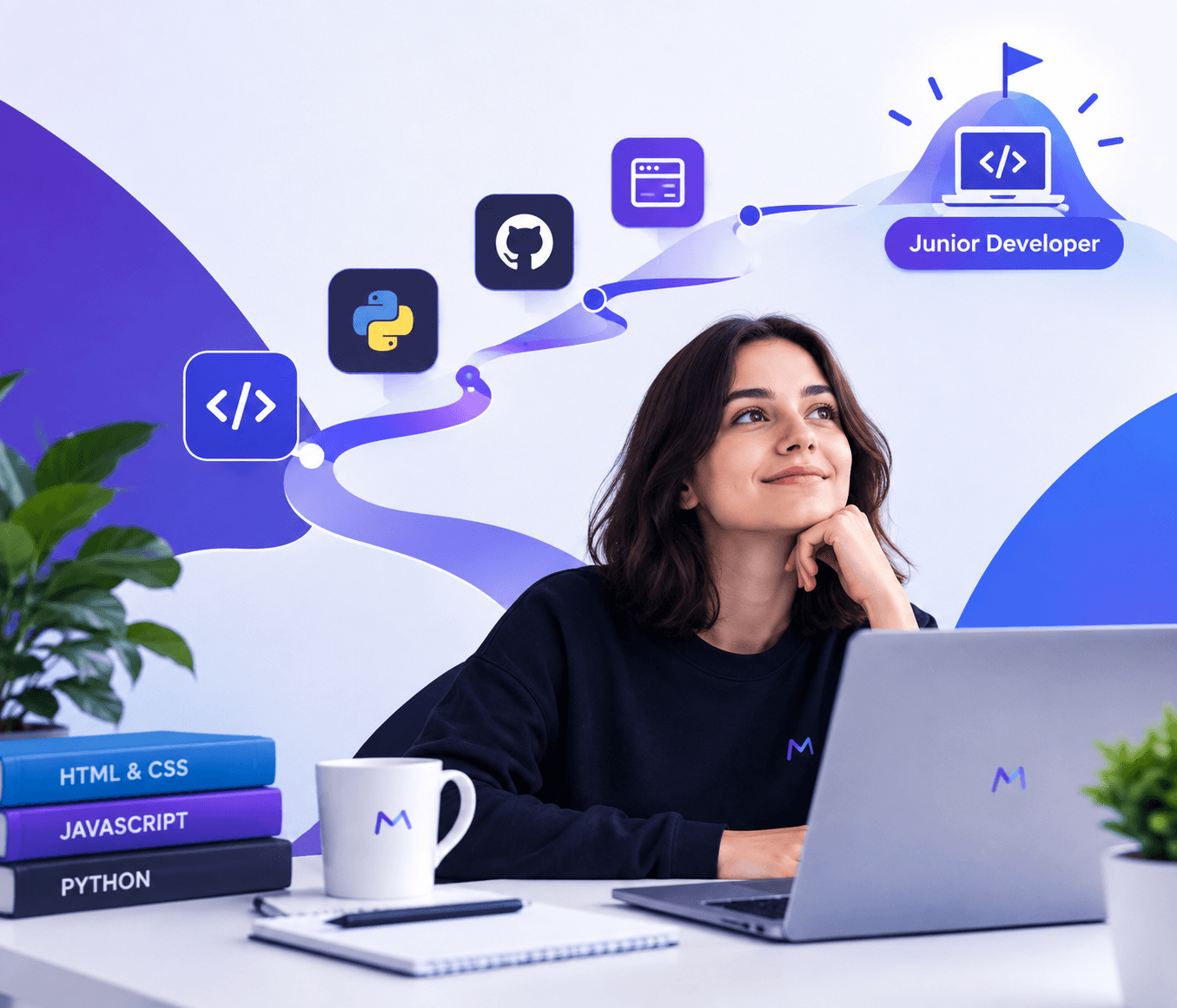
In recent years, the IT industry has become one of the most attractive fields for people who want to build a new career or change their existing profession. Programming, web development, artificial intelligence, cybersecurity, and other technology-related fields offer a wide range of opportunities for people who want to develop new skills and build a long-term career.
But how can you switch to an IT career? Can someone with no previous programming experience start from scratch and eventually become a Junior Developer?
The answer is yes. However, instead of trying to learn random programming languages and technologies, it is much more effective to follow a clear direction, build a structured learning plan, and gain practical experience through real projects.
In this article, we will explore a step-by-step roadmap for learning programming from scratch, choosing your first programming language, building projects, creating a portfolio, and preparing for your first Junior Developer position.
Is Programming Necessary to Enter the IT Industry?
IT is a very broad field, and not every IT career requires programming. However, one of the most popular career paths within technology is software development and web development.
If your goal is to become a developer, learning the fundamentals of programming is essential.
Becoming a developer is not simply about memorizing the syntax of a programming language. The real goal is to develop the ability to:
-
Think logically
-
Analyze problems
-
Build algorithms
-
Write code
-
Find and fix errors
-
Develop projects
-
Learn new technologies
For this reason, if you want to make an IT career change, your first step should be to choose a specific career direction and then identify the skills and technologies required for that path.
1. First Step: Which IT Career Path Should You Choose?
One of the biggest mistakes beginners make when entering the IT industry is trying to learn everything at the same time.
Starting with Python, JavaScript, React, Java, SQL, AI, cybersecurity, and many other technologies simultaneously can make the learning process overwhelming.
It is much more effective to choose one direction first.
Some popular IT career paths include:
Frontend Development
Frontend development focuses on creating the parts of websites and web applications that users see and interact with.
Common technologies include:
HTML → CSS → JavaScript → React
Backend Development
Backend development focuses on the server side of applications, databases, APIs, and business logic.
Technologies such as Python, JavaScript/Node.js, Java, and others can be used in this field.
Data and Python
Python is widely used in data analysis, automation, artificial intelligence, and machine learning.
Cybersecurity
Cybersecurity focuses on protecting systems, networks, applications, and data from security threats.
If you are looking for a clear starting point, Frontend Development can be an interesting option for beginners because you can immediately see the results of your code in a web browser.
2. How to Start Learning Programming From Scratch?
At the beginning, the most important thing is to understand the basic logic behind programming.
Beginners should gradually become familiar with concepts such as:
-
Variables
-
Data types
-
Operators
-
Conditional statements
-
Loops
-
Functions
-
Arrays
-
Objects
-
Algorithms
For example, if you are learning JavaScript, simply memorizing code is not enough. You need to understand how and why the code works.
A useful way to think about programming is:
Problem → Logic → Algorithm → Code → Test → Result
Developing this way of thinking will also make it easier to learn other programming languages in the future.
3. Which Programming Language Should You Choose?
The answer depends on the career path you choose.
If you want to become a Frontend Developer, HTML, CSS, and JavaScript are among the fundamental technologies you should learn.
If you are interested in data, automation, or artificial intelligence, Python can be a strong starting point.
The important question is not whether one programming language is “the best.”
Instead, ask:
“Which technologies do I need for the career path I want to pursue?”
This approach makes your learning journey more focused and efficient.
4. Can You Become a Developer by Only Watching Courses?
No. Watching courses alone is not enough.
One of the most important skills in IT is the ability to apply what you have learned in practice.
For example, if you are learning JavaScript, build a small project after learning each major topic.
You could create:
-
Calculator
-
To-Do List
-
Quiz App
-
Weather App
-
Shopping Cart
-
Expense Tracker
-
Interactive Form
These projects help you understand how programming concepts are used in real applications.
There is a major difference between reading about a programming concept and actually being able to use it.
That is why learning coding through practical projects is so important.
5. Why Is a Portfolio Important?
When applying for IT jobs, simply writing “I know JavaScript” on your CV may not be enough.
Employers also want to understand what you can actually build.
That is why anyone who wants to become a Junior Developer should start building a portfolio.
Your portfolio could include projects such as:
-
Personal portfolio website
-
Responsive landing page
-
To-Do application
-
Product catalog
-
Shopping cart
-
API-based application
-
Login and registration system
-
Dashboard
-
Interactive web application
The number of projects is not necessarily the most important factor.
It is better to have several well-built projects that you can confidently explain than dozens of copied projects that you do not fully understand.
6. Learn Git and GitHub
For anyone who wants to become a Junior Developer, learning tools such as Git and GitHub is also valuable.
Git allows developers to track changes in their code and manage different versions of a project.
GitHub is widely used to store, share, and collaborate on software projects.
Publishing your projects on GitHub gives you practical experience and allows potential employers to see your work.
At the beginner level, you should become familiar with concepts such as:
-
Creating a repository
-
Making commits
-
Understanding branches
-
Push and pull
-
Sharing repositories
These skills can become an important part of your developer workflow.
7. Is Learning Programming Still Important in the Age of AI?
Artificial intelligence is changing the way developers work, and the number of AI-powered development tools continues to grow.
AI can help developers generate code, explain errors, and complete certain tasks more quickly.
However, this does not eliminate the need to understand programming.
In fact, understanding programming becomes even more important when you need to:
-
Check whether AI-generated code is correct
-
Identify security issues
-
Understand the logic behind the code
-
Modify generated code
-
Integrate code into an existing project
For this reason, a modern developer should not think of AI and programming as alternatives.
A better approach is to learn how to use AI as a tool that improves the programming process.
Strong programming fundamentals combined with effective AI tools can become a powerful combination for modern developers.
8. How Long Does It Take to Become a Junior Developer?
There is no universal timeline for becoming a Junior Developer.
The learning process depends on several factors, including:
-
How many hours you study each week
-
Your previous technical experience
-
The career path you choose
-
The amount of practical work you complete
-
Access to teacher or mentor support
-
Independent study
-
Consistency
Instead of asking, “How many months will it take me to become a developer?”, it is more useful to ask what skills you can develop at each stage.
For example, someone pursuing frontend development may begin with HTML and CSS, move to JavaScript, and then continue with modern frontend technologies and frameworks.
The quality and consistency of your learning are generally more important than simply counting the number of months.
9. What Should You Know Before Applying for a Job?
Before applying for Junior Developer positions, ask yourself the following questions:
Do I understand the fundamentals of programming?
Can I build a small project independently?
Can I investigate and fix errors in my code?
Can I use Git and GitHub?
Can I explain my portfolio projects?
Can I answer basic programming questions during a technical interview?
If you can confidently answer “yes” to most of these questions, you may be ready to start applying for entry-level positions.
Remember that you do not need to know every technology before applying for your first job.
The goal at the junior level is to demonstrate a strong foundation, practical skills, problem-solving ability, and a willingness to continue learning.
10. A Practical Roadmap for Switching to an IT Career
For someone starting from scratch, a simple roadmap could look like this:
Stage 1 — Learn the Fundamentals
Start with programming logic, variables, conditions, loops, functions, and basic algorithms.
Stage 2 — Choose a Career Direction
Choose one path such as Frontend Development, Backend Development, Python/Data, Cybersecurity, or another IT specialization.
Stage 3 — Learn the Core Technologies
Learn the programming language and technologies required for your chosen career path.
Stage 4 — Build Projects
Create practical projects that solve real or realistic problems.
Stage 5 — Learn Git and GitHub
Learn how to manage your code and publish your projects.
Stage 6 — Build Your Portfolio and CV
Present your skills, experience, and projects in a professional and clear way.
Stage 7 — Prepare for Technical Interviews
Practice coding problems, technical questions, and explaining your projects.
Stage 8 — Apply for Junior Positions
Start applying for positions such as Junior Developer, Junior Frontend Developer, and other relevant entry-level roles.
How Can You Make Your IT Career Change More Effective?
Learning technology is only one part of the process. Your approach to learning can make a significant difference.
Instead of studying for hours without a clear goal, create a realistic weekly schedule.
For example:
Learn → Practice → Build → Review → Repeat
Spend part of your time learning new concepts, but dedicate enough time to writing code and building projects.
It is also important to become comfortable with making mistakes.
Programming rarely works perfectly on the first attempt. Errors, bugs, and failed solutions are a normal part of the development process.
Every bug you investigate is an opportunity to improve your problem-solving skills.
Common Mistakes People Make When Switching to IT
People changing careers often make several common mistakes.
Trying to Learn Everything
You do not need to learn every programming language or framework. Choose one direction and build a strong foundation first.
Watching Too Many Tutorials
Tutorials can help you learn, but passive learning is not enough. Write code and build projects.
Copying Projects Without Understanding Them
A project only becomes valuable when you understand how and why it works.
Ignoring Fundamentals
Jumping directly into advanced frameworks without understanding programming fundamentals can create problems later.
Giving Up Too Early
Programming can feel difficult at first. Progress usually comes from consistency rather than trying to learn everything quickly.
Conclusion: Is an IT Career Change Possible?
Yes, it is possible.
However, switching to IT is not about learning every technology within a few weeks.
A more effective approach is:
Choose a direction → Learn the fundamentals → Practice → Build projects → Create a portfolio → Prepare for interviews → Apply for jobs.
If you are starting from zero, do not try to learn everything at once. Choose one direction and consistently develop your skills in that area.
Remember that becoming a Junior Developer is not the end of the journey — it is the beginning of your professional development.
Your first goal should not be to know every technology. Instead, focus on building a strong programming foundation, creating real projects, developing problem-solving skills, and proving that you can continue learning.
Whether you want to become a Frontend Developer, Backend Developer, Python Developer, or another type of IT professional, a structured learning path can make the transition much more manageable.
The technology industry continues to evolve, and developers are expected to keep learning throughout their careers. The ability to learn new tools, adapt to change, solve problems, and build useful products can be just as important as knowing a particular programming language.
So, if you have been thinking about switching to IT, learning programming, or becoming a Junior Developer, you do not need to know everything before you begin.
You simply need to take the first step.
Choose your direction. Start learning. Build something. Keep improving. Your IT career can start from there.