


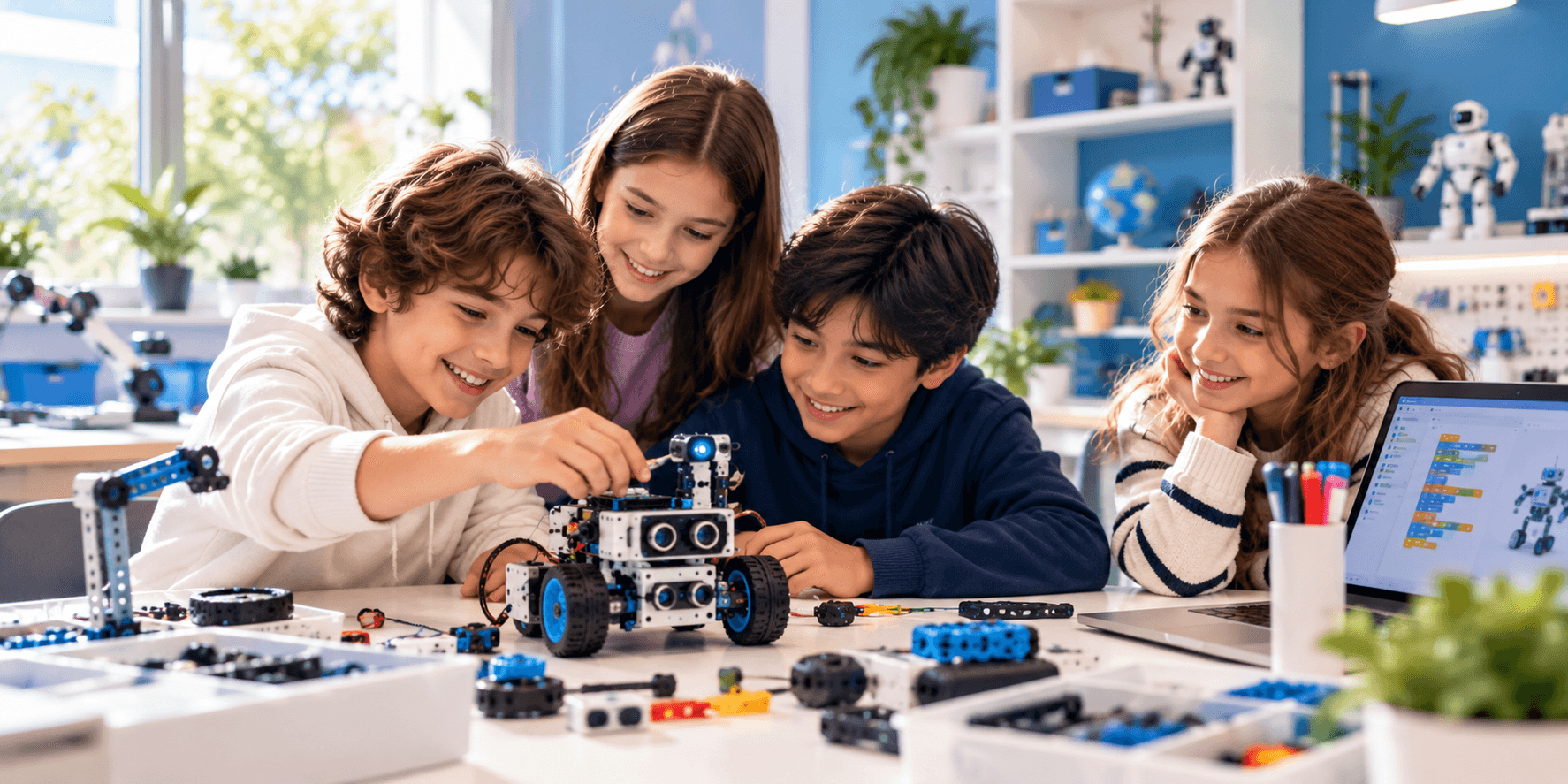
Today, robots are no longer just technologies we see in movies. They are used in industry, medicine, education, and many different areas of everyday life.
But what does robotics mean for children?
Robotics teaches children more than just how to build robots. It also helps develop logical thinking, problem-solving, planning, and creativity.
🧠 Develops Logical Thinking
For a robot to perform a specific task, a child first needs to think: “What do I want to do, and how can I make it happen?”
For example, making a robot move requires choosing the correct sequence of commands. This teaches children to understand connections between actions and think step by step.
🔧 Strengthens Problem-Solving Skills
In robotics, everything does not always work on the first try. If a robot does not move or a program does not work correctly, children need to find the cause of the problem and try different solutions.
As a result, instead of simply saying, “It didn’t work,” they start asking: “What can I change to make it work?”
💡 Encourages Creativity
Robotics gives children an opportunity to bring their own ideas to life. Instead of simply copying a ready-made model, they can change its design, add new functions, and come up with different solutions.
In this way, technical knowledge and creativity come together.
🔍 Teaches Children to Learn from Mistakes
Robotics helps children understand that mistakes are a natural part of the learning process.
While working on a project, a child may test an idea several times, find a mistake, and try again. This process helps them become more patient, face challenges with confidence, and keep working until they achieve a result.
🤝 Teamwork and Communication
Robotics projects also create great opportunities for children to work together. They share ideas, learn to listen to each other, and cooperate to achieve a common goal.
This helps develop not only technical knowledge but also communication and teamwork skills.
🚀 Robotics Is More Than Just Building Robots
During a robotics class, a child does more than simply build a robot. They think, plan, test, make mistakes, and try again.
This entire process develops an important mindset: if there is no ready-made solution, I can try to find one myself.
Technology will continue to change, and new professions will emerge. But the ability to think, learn, solve problems, and create will always remain important.
Maestro School helps children not only use technology, but also understand it and develop the ability to turn their own ideas into reality through technology. 🤖🚀