

Children’s interest in technology is growing every day. Simply knowing how to use a computer is no longer enough — many children want to create their own games, animations, websites, and digital projects. This is why one of the most common questions parents ask is: “Which programming language should my child start with: Scratch, Python, or JavaScript?”
In reality, there is no single answer to this question. The right choice depends on the child’s age, previous experience, interests, learning style, and goals in programming.
Scratch, Python, and JavaScript each serve different purposes. The goal should not be to start a child with the most difficult or popular programming language, but to help them discover programming in a way that is engaging, understandable, and enjoyable.
Why Is Programming Important for Kids?
Programming is much more than simply writing code. While coding, children learn how to break a problem into smaller parts, create logical sequences, identify mistakes, and turn their ideas into working projects.
Learning to code can help children develop important skills such as:
-
Logical thinking
-
Problem-solving
-
Creativity
-
Systematic thinking
-
Attention and patience
-
Algorithmic thinking
-
Independent learning
For this reason, when choosing programming classes for kids, parents should not only ask, “Which programming language will my child learn?” but also, “How will this language support my child’s learning and development?”
What Is Scratch and Why Is It a Good Starting Point for Kids?
Scratch is a visual, block-based programming environment. Instead of writing traditional lines of code, children create programs by connecting different blocks together.
With Scratch, children can create interactive stories, games, and animations. Scratch is officially designed primarily for children between 8 and 16 years old, although people of all ages use the platform.
One of the biggest advantages of Scratch is that children can learn programming logic without immediately struggling with complicated programming syntax.
For example, a child can create logic such as:
“When the button is clicked → the character moves.”
Later, this logic can be expanded using variables, conditions, loops, and events.
This makes programming more visual, interactive, and accessible for beginners.
Who Is Scratch Suitable For?
Scratch can be particularly suitable for children who:
-
Are completely new to programming
-
Enjoy games and animations
-
Feel uncomfortable with traditional code
-
Prefer visual learning
-
Need to develop basic algorithmic thinking
The main goal is not to make children write complicated code immediately. The goal is to give them the feeling:
“I can create my own program!”
That sense of achievement can be an important first step toward developing a long-term interest in coding.
Is Python Suitable for Kids?
Yes. Python is a text-based programming language, meaning that children write actual code instead of connecting visual blocks.
Python is widely considered a beginner-friendly language because of its relatively simple and readable syntax. This makes it a strong option for students who are ready to move from visual programming to traditional coding.
With Python, children can learn concepts such as:
-
Variables
-
Conditional statements
-
Loops
-
Functions
-
Lists
-
Logical operations
-
Basic algorithms
They can then use these concepts to create their own projects.
For example, students can build a simple calculator, number-guessing game, quiz application, or text-based game.
When Should a Child Move to Python?
If a child already understands basic programming concepts, moving to Python can be a valuable next step.
However, age should not be the only factor. A child’s readiness, interest, and ability to understand programming logic are often more important.
Some children may be ready for text-based programming at a relatively young age, while others may benefit from starting with Scratch and gradually moving toward traditional coding.
Therefore, saying that “Python is only for older children” is not necessarily correct.
What About JavaScript?
JavaScript can be an especially interesting option for children who are interested in websites and web development.
JavaScript is widely used to add interactivity and dynamic behavior to websites. Buttons, forms, animations, interactive elements, and many web-based applications can be powered by JavaScript.
This gives children an opportunity to see the results of their code directly in a web browser.
A simple way to understand the relationship is:
HTML → Website structure
CSS → Website design and appearance
JavaScript → Website behavior and interactivity
For children who are interested in web development and frontend programming, JavaScript can therefore be a valuable direction.
JavaScript also introduces students to fundamental programming concepts such as variables, conditions, loops, functions, and events.
Scratch, Python, or JavaScript: Which One Should You Choose?
The differences can be summarized like this:
| Programming Language | Suitable Stage | Main Advantage |
|---|---|---|
| Scratch | Beginner | Visual and game-based learning |
| Python | Beginner to intermediate | Simple syntax and strong programming foundation |
| JavaScript | Students interested in web development | Interactive web projects |
However, this table should not be treated as a strict rule.
For example, one 10-year-old may start with Scratch and later move to Python. Another child of the same age may already be interested in creating websites and may be ready to explore HTML, CSS, and JavaScript.
This is why the role of the teacher and curriculum is extremely important.
What Could an Ideal Programming Path for Kids Look Like?
For many children, a gradual learning path can make programming easier and more enjoyable.
Stage 1 — Scratch
At the first stage, children learn the basic logic of programming.
They can explore:
-
Sequences
-
Events
-
Conditions
-
Loops
-
Variables
-
Basic algorithms
Instead of learning these concepts only through theory, students can apply them while creating games and animations.
This allows children to connect programming concepts with something they can actually see and interact with.
Stage 2 — Python
The next stage can involve moving from blocks to text-based programming.
Children begin writing real code and working with concepts such as:
if
for
while
function
variable
They can use these concepts to solve problems and build increasingly complex projects.
This stage can significantly strengthen a child’s programming and computational thinking skills.
Stage 3 — Web Development and JavaScript
If a student becomes interested in websites and interactive digital experiences, the next step can be HTML, CSS, and JavaScript.
At this point, children can create their own web pages and add interactive features using JavaScript.
They can see how their code directly changes the behavior of a website, which can make the learning process particularly engaging.
Can a Child Start Directly With Python or JavaScript?
Absolutely.
The important factor is not simply the child’s age but their readiness and interest in learning programming.
If a child is already comfortable using computers, enjoys logical challenges, and is interested in coding, starting directly with Python or JavaScript can be a suitable option.
On the other hand, if a child is completely new to programming and enjoys games, characters, and creative animations, Scratch may provide a more comfortable introduction.
The main goal should not be to make programming feel like a difficult school subject.
Children should be able to see what they are creating.
When children can see the results of their work, they are more likely to become curious, experiment with new ideas, and continue learning.
What Should Parents Consider When Choosing a Programming Language?
The name of the programming language should not be the only consideration. The structure and quality of the learning program are equally important.
Parents can ask the following questions:
Does the child create real projects?
Instead of focusing only on theory, children should have opportunities to create games, animations, websites, and other projects. Project-based learning can make coding more meaningful and engaging.
Is the curriculum appropriate for the child’s age?
A program designed for a 7-year-old should not necessarily be the same as one designed for a 14-year-old. Children learn differently at different stages of development.
Can the child create their own projects?
Copying ready-made code is very different from creating something independently. Giving children opportunities to turn their own ideas into projects can help develop creativity and problem-solving skills.
How does the teacher handle mistakes?
Programming involves errors. When something does not work, the learning opportunity comes from understanding why.
Instead of immediately giving the answer, an effective learning environment can encourage children to investigate the problem, identify the error, and find a solution.
Scratch, Python, or JavaScript: What Is the Final Answer?
The real question is not:
“Which programming language is the best?”
A better question is:
“Which programming language is best for my child at this stage?”
If a child is completely new to programming and enjoys visual and creative projects, Scratch can be an excellent starting point.
If a child is ready for text-based programming and wants to develop a stronger programming foundation, Python can be a great choice.
If a child is interested in websites, interactive pages, and frontend development, JavaScript can be a suitable direction.
Ultimately, the best results come not simply from learning a programming language, but from using programming knowledge to build real projects.
That is why the goal of programming education for kids should not be limited to teaching them how to write code. It should help children become creative thinkers, problem-solvers, and confident creators who can use technology to turn their ideas into reality.
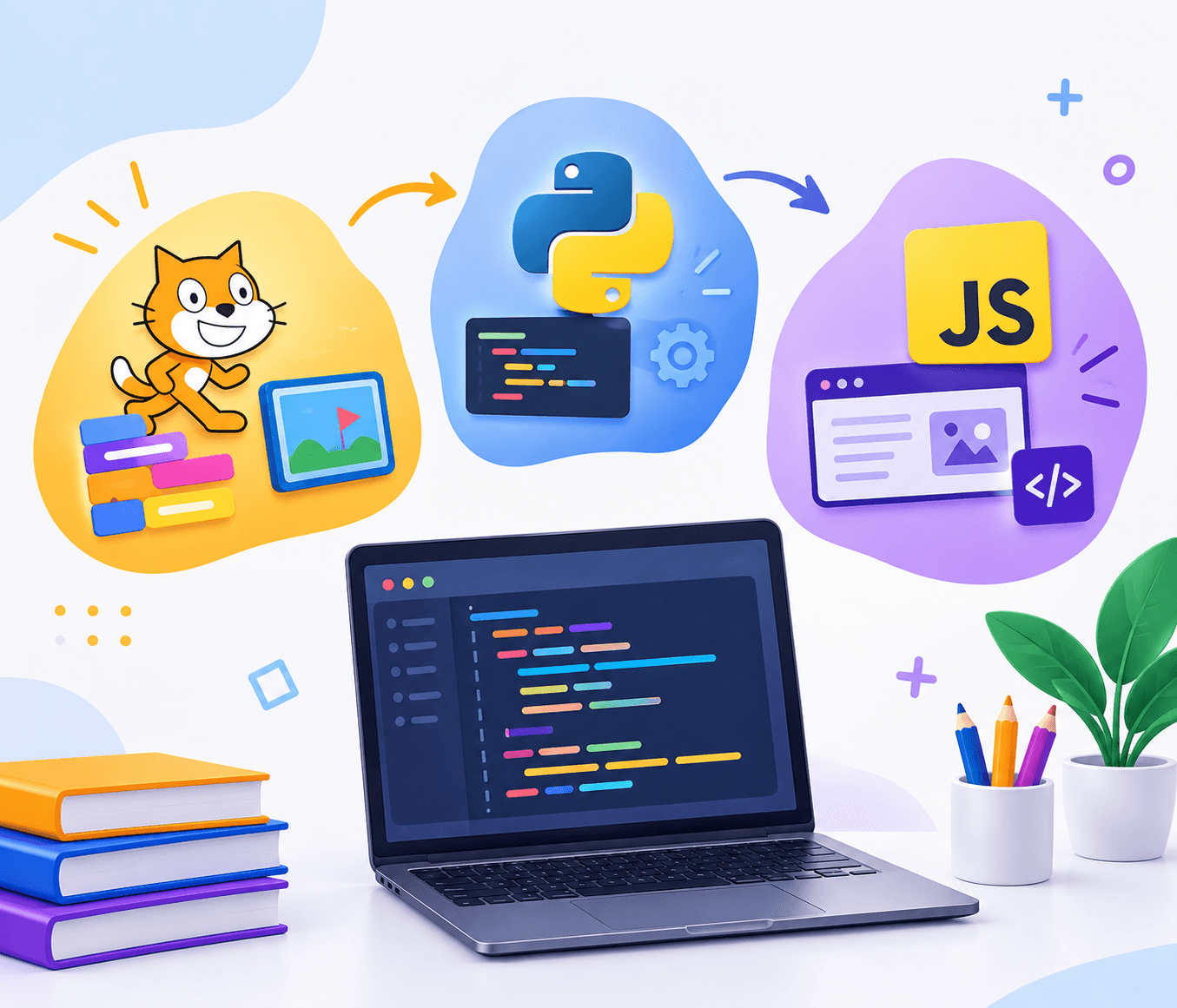
For many students, a learning path such as Scratch → Python → JavaScript can provide a strong progression. However, this is not a mandatory path for every child.
The best learning journey is the one that considers the child’s age, interests, experience, learning pace, and future goals.
Whether a child starts with Scratch, Python, or JavaScript, the most important thing is to make the first experience with programming interesting, creative, and rewarding.