


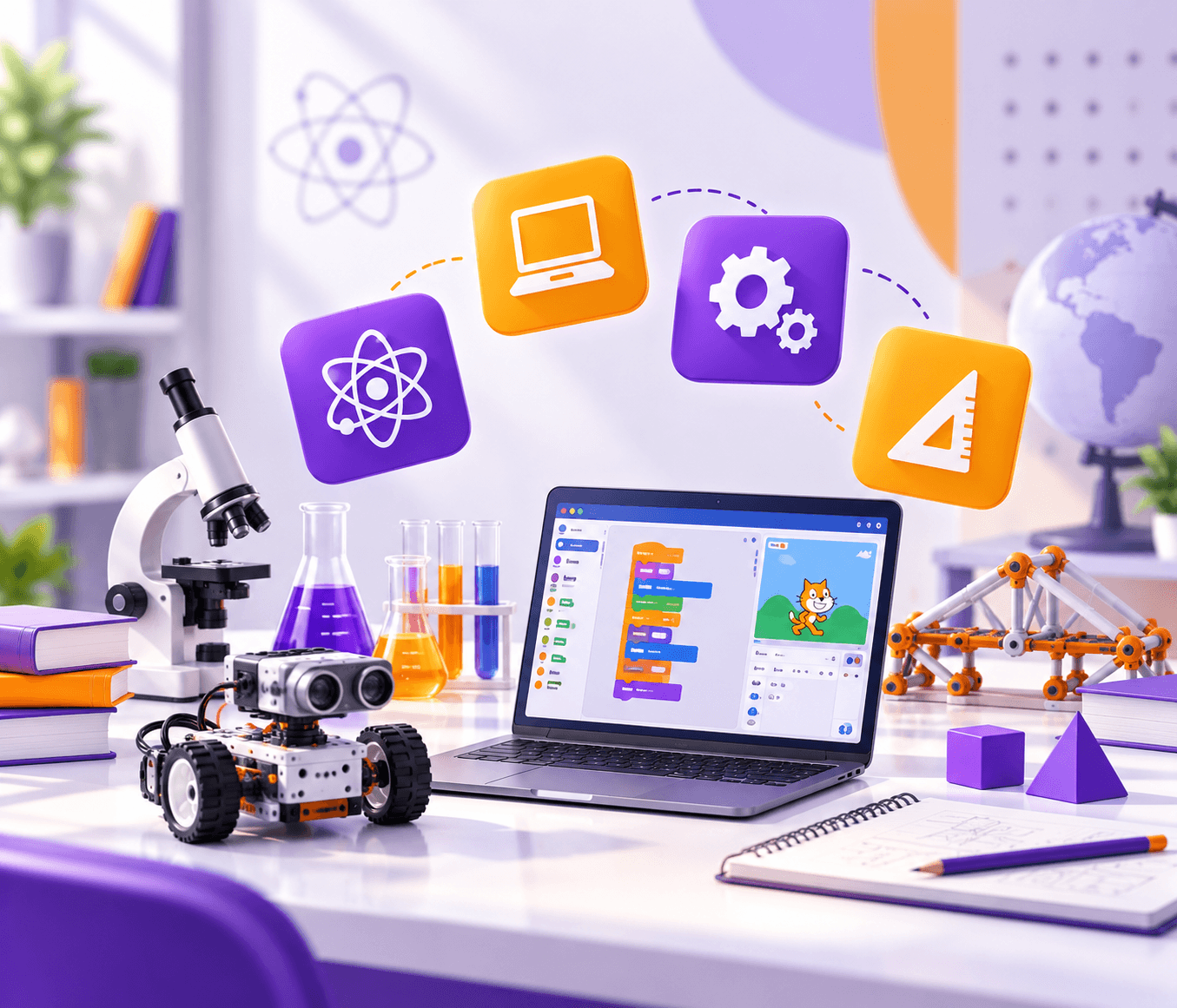
In a world where technology is developing rapidly, preparing children for the future is no longer limited to the subjects they learn at school. Areas such as science, mathematics, technology, and engineering play an important role in developing children's academic and practical skills. This is exactly where STEM education comes in, becoming one of the most popular educational approaches for children in recent years.
But what is STEM? Why is STEM education important for kids? What skills can children develop through STEM?
In this article, we will explain what STEM education is, explore the 7 main benefits of STEM for kids, and discuss what parents should consider when choosing a STEM program for their children.
What Is STEM?
The word STEM comes from the first letters of four major fields:
-
S — Science
-
T — Technology
-
E — Engineering
-
M — Mathematics
STEM education is not simply about teaching these subjects separately. Instead, it focuses on connecting them and applying them through practical activities.
For example, when a child builds a robot, they are not only learning how the robot works. They may also use mathematical calculations, apply engineering principles, work with technology, and use scientific thinking to solve problems.
That is why STEM education for kids is much more than just another class. It is an educational approach that helps children understand how things work, approach real-world problems from different perspectives, and find their own solutions.
Why Is STEM Education Important for Kids?
Children are naturally curious. They want to understand why things happen, how objects work, and how they can create something of their own.
STEM education turns this natural curiosity into part of the learning process.
Instead of simply giving children the correct answer, STEM encourages them to ask:
“How do you think we can solve this?”
Children can then try different approaches, make mistakes, analyze the results, and try again.
Through this process, children do not simply learn a specific topic. They also develop critical thinking, research, problem-solving, and analytical skills.
7 Key Benefits of STEM for Kids
1. Develops Problem-Solving Skills
One of the biggest advantages of STEM education is that it teaches children to find their own solutions instead of simply looking for ready-made answers.
For example, a child may be asked to build a bridge using a specific set of materials. Their first attempt may not work. The bridge may collapse or fail to carry the expected weight.
At this point, the child begins to analyze the problem:
-
What went wrong?
-
Which part of the structure is weak?
-
How can the design be changed?
-
Could another material be used?
This process helps children develop a more systematic approach to problems they may encounter in real life.
STEM does not only teach children the answer; it teaches them how to find the answer.
2. Strengthens Logical and Analytical Thinking
STEM activities encourage children to observe, compare information, analyze results, and draw conclusions.
For example, when working on a programming task, a child may need to determine the correct sequence of steps to solve a problem.
In a robotics project, they may need to figure out which commands are necessary for a robot to move in a particular direction.
These activities help children develop the ability to:
-
understand cause-and-effect relationships;
-
analyze information;
-
create sequences;
-
make logical decisions;
-
identify mistakes.
These skills are useful not only in STEM subjects but also in children's everyday lives and future education.
3. Encourages Creativity and New Ideas
STEM is not only about mathematics and technology. Creative thinking is also an important part of the STEM approach.
A problem can often have more than one possible solution.
For example, children may be asked to build the tallest tower using a specific set of materials. Each child may approach the challenge differently.
One child may create a wider base, another may use the shape of the materials differently, while another may come up with a completely new construction idea.
Activities like these show children that a problem does not always have only one correct solution.
This helps develop creative and flexible thinking.
4. Teaches Children Not Only to Use Technology, but to Create With It
Today's children become familiar with technology from an early age. Phones, tablets, computers, and other digital devices are already part of their everyday lives.
However, there is a big difference between using technology and understanding how technology works.
STEM education helps children move beyond being simple technology users and become creative problem-solvers and creators.
For example, children can:
-
write simple programs;
-
program robots;
-
create electronics projects;
-
build digital models;
-
develop interactive projects.
As a result, children can begin to see technology not only as a source of entertainment, but also as a tool for learning, creating, and solving problems.
5. Develops Teamwork and Communication Skills
STEM projects are often completed in teams. When several children work together, each child may have a different role.
For example:
-
one child develops the idea;
-
another builds the structure;
-
another works on the programming;
-
another presents the project.
This process teaches children how to listen to others, explain their ideas, take responsibility, and collaborate as part of a team.
Teamwork is one of the most important skills children will need in school, university, and their future careers.
STEM education gives children an opportunity to develop this skill through practical activities.
6. Teaches Children Not to Be Afraid of Mistakes
One of the most valuable aspects of STEM for kids is that a project does not have to be perfect on the first attempt.
In fact, sometimes a failed attempt becomes one of the most valuable parts of the learning process.
For example, a child builds a robot, but the robot does not move correctly. Instead of immediately giving the child the solution, the goal is to encourage them to ask:
“Where is the problem?”
The child can then investigate, change the code, modify the structure, or try a different approach.
This process helps children develop patience, persistence, and a growth mindset.
Children learn that making a mistake does not mean failure. A mistake can be an opportunity to make the next attempt better.
7. Prepares Children for Future Careers
As technology develops, the job market also changes. New professions and new skill requirements continue to emerge.
Programming, artificial intelligence, robotics, data analytics, engineering, and other technology-related fields are becoming increasingly important.
Of course, not every child needs to become a programmer or engineer in the future.
However, the skills developed through STEM can be useful across many different careers:
-
problem-solving;
-
analytical thinking;
-
creativity;
-
technology skills;
-
teamwork;
-
project development;
-
critical thinking.
That is why STEM education for kids is broader than simply preparing children for one specific career. It helps them develop skills that can support them in a rapidly changing world.
What Can Kids Do in STEM Classes?
One of the reasons STEM education is so engaging for children is that learning is often practical and project-based.
Depending on their age and the program, children can work on different types of projects, including:
-
robotics projects;
-
engineering structures;
-
programming challenges;
-
Scratch projects;
-
electronics experiments;
-
3D modeling;
-
mathematical logic games;
-
science experiments;
-
different STEM challenges.
Through these activities, children gain theoretical knowledge while also learning how to apply that knowledge to real projects.
What Age Is STEM Suitable For?
There is no single age at which children must start STEM education. The most important factor is that the program is appropriate for the child's age and developmental level.
For younger children, STEM activities can take the form of games, building activities, simple experiments, and visual challenges.
As children grow, they can gradually move toward more advanced projects:
Simple Experiments → Building Activities → Robotics → Programming → Engineering Projects
For example, a younger child might build a simple structure, while an older child could add sensors and programming elements to the same type of project.
The goal is not to overload children with advanced concepts too early. Instead, it is about keeping their curiosity alive while allowing them to develop step by step.
What Should Parents Look for When Choosing a STEM Course?
When choosing a STEM course for kids, looking only at the course curriculum is not enough.
Parents should also consider the following:
Are the lessons practical?
Children should not simply listen to a teacher. They should have opportunities to experiment and work on projects themselves.
Is the program age-appropriate?
The way STEM is taught to a 5-year-old should not be the same as the way it is taught to a 12-year-old.
Do children create projects?
Project-based learning allows children to apply their knowledge in practical situations.
Does the teacher guide children rather than simply give answers?
In STEM education, the teacher's role is not only to provide information. It is also important to encourage children to think, ask questions, and discover solutions.
Are children encouraged to be creative?
Instead of asking children to simply reproduce a predetermined result, they should have opportunities to test their own ideas and approaches.
How Does STEM Complement School Education?
STEM education does not replace school education. Instead, it can complement what children learn at school by giving them opportunities to apply their knowledge in practical situations.
For example, a child who learns a mathematical concept at school can apply that knowledge to a STEM project.
Similarly, theoretical knowledge from physics, computer science, and other subjects can become easier to understand when children apply it through hands-on projects.
In this way, STEM education can create a bridge between theoretical knowledge and practical experience.
Conclusion
STEM education does not simply teach children science, technology, engineering, and mathematics. It also helps shape the way children think about the world and approach problems.
Through STEM, children can learn how to:
-
solve problems;
-
think logically and analytically;
-
develop creative ideas;
-
use technology in meaningful ways;
-
work as part of a team;
-
learn from mistakes;
-
develop and present projects.
Most importantly, children discover that learning is not limited to books and classrooms. They ask questions, investigate, experiment, make mistakes, try again, and turn their ideas into real projects.
In the future, alongside technological knowledge, skills such as critical thinking, creativity, problem-solving, and the ability to learn will continue to be highly valuable.
That is why introducing children to STEM from an early age can become a valuable experience for their academic and personal development.
The main goal of STEM is not to make children memorize the answers of the future. It is to teach them how to think so they can find their own answers to the problems of the future.